
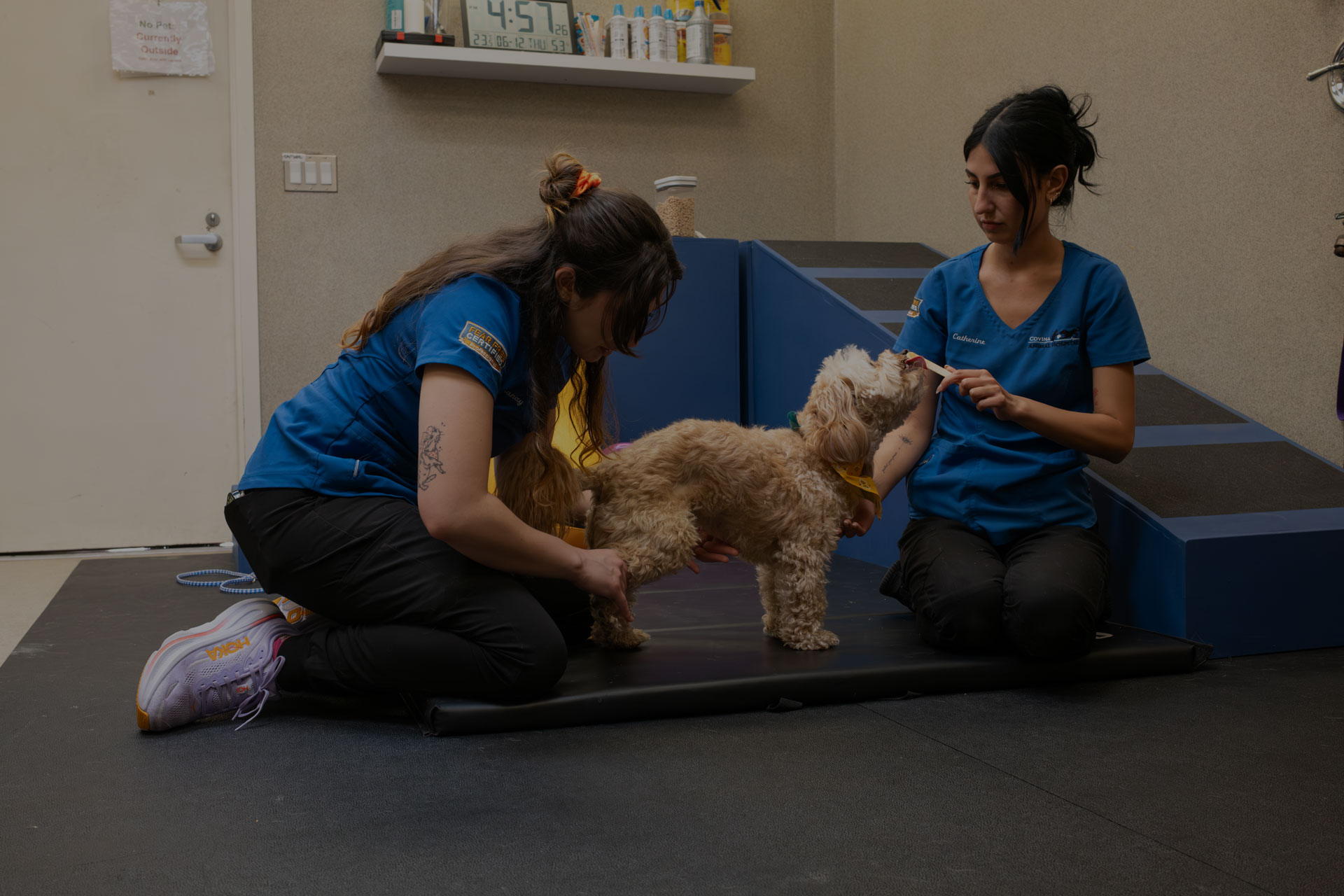
Dog Rehabilitation in Covina with a CCRT-Certified Veterinarian

Dr. Carmen Lu trained at UC Davis and the Canine Rehabilitation Institute. She evaluates, diagnoses, and builds a plan around your individual dog, not a checklist. Request Appointment Rehab Inquiry Form

What is Canine Rehabilitation Therapy? Canine rehabilitation therapy is physical therapy for dogs — the same kind of structured movement, manual treatment, and conditioning work humans do after surgery, an injury,as a chronic condition progresses, or for maintenance. It can help dogs recover from procedures like CCL repair, manage arthritis and joint disease, retrain coordination after IVDD or other neurological events, and can help slow the loss of mobility that comes with aging. The goal is rarely "back to normal," but most dogs may reach a new level of normal that's specific to their body, their condition, and their daily life. Rehab is what gets them there.

Dr. Lu trained at UC Davis (DVM, 2020) and the Canine Rehabilitation Institute (CCRT, 2023), and is listed in CRI's national therapist directory. She is the only CCRT-led rehab veterinarian in the east San Gabriel Valley. Why a CCRT-Certified Veterinarian Matters CCRT (Certified Canine Rehabilitation Therapist) is a credential used to demonstrate advanced training in canine rehab. The Canine Rehabilitation Institute teaches it through coursework, clinical hours, and case work specific to dog biomechanics, post-surgical recovery, and neurological cases.

Veterinarians, physical therapists, and, more recently, occupational therapists may pursue training and earn their CCRT certification. In California, animal physical rehabilitation therapy must be supervised by a veterinarian to establish a valid veterinarian-client-patient relationship (VCPR), even when a CCRT-certified professional is involved. This requirement helps protect animals by limiting treatment provided by unlicensed or untrained individuals, which could otherwise result in unnecessary harm or discomfort.

For your pet, the combination of a DVM and CCRT means one clinician sees the whole picture of your dog’s injury and treatment. As a CCRT, Dr. Lu can evaluate, design, discuss, and deliver a customized rehab treatment plan for your pet, but as a veterinarian, Dr. Lu is also able to recommend the appropriate diagnostics, make diagnoses, and recommend or prescribe medications.

Milo, a 5-year-old terrier mix tore his cranial cruciate ligament chasing a ball at the dog park last spring. His owner opted for surgical repair followed by a structured rehabilitation program — starting with cold laser and gentle range-of-motion work in the early weeks, then progressing to therapeutic exercise and underwater treadmill sessions as he regained strength. Eight weeks into rehab, Milo was bearing full weight on the leg; by week twelve, he was back to his characteristically exuberant self, with his owner reporting he hadn't seen that kind of effortless trot since Milo was a puppy. Rehabilitation for Cranial Cruciate Ligament (CCL/ACL) Injuries A torn cranial cruciate ligament (the canine equivalent of a torn ACL in people) is one of the most common orthopedic injuries Dr. Lu sees. For dogs going through surgery, like a TPLO, rehab supports both sides of the procedure: keeping the dog comfortable and maintaining muscle while waiting, then rebuilding strength, restoring range of motion, and reducing the chance of injury to the other knee.

Dogs who do rehab after a TPLO are nearly two times more likely to regain full function at 8 weeks, while dogs who skip it are nearly three times more likely to still be struggling. Six months out, dogs who do rehab also show less arthritis.

For dogs whose path is non-surgical, rehab is the plan itself: managing pain, preserving mobility, and protecting the joint over time. Dr. Lu builds each plan around the individual dog, evaluating how they're moving, where they're hurting, and their owner's goals.

"My 9-year-old boxer Schatzi fell off a ledge four and a half years ago. I took her to a couple of vets and opted out of surgery — I didn't want to go that route if I didn't have to. I found out Covina Animal Hospital does laser therapy and brought her here. The staff is awesome. After a year or two they added physical therapy, and Schatzi now gets both. The improvement is phenomenal; she acts more like a pup than an older dog now. I noticed it within a couple of weeks. That's why I keep coming."

— Debbie Young
Rehabilitation for Dog Arthritis (Degenerative Joint Disease) Most older dogs develop some degree of arthritis—called degenerative joint disease, or DJD—as they age. The plan pairs in-clinic sessions like manual therapy, therapeutic exercise, and cold laser with a home exercise program owners weave into their pet’s daily life. Pets who receive these therapies show significant improvements in pain levels and mobility, and can also decrease the amount of pain medication they need to stay comfortable.

The goal, in Dr. Lu's words, is "a new level of normal": maintaining mobility and your pet’s overall comfort and quality of life. Dr. Lu tailors each rehab plan to what the dog can actually do, what owners may be able to do at home, and the rehab team adjusts each session based on patient response.

Meet Bruce, a spunky 11-year-old English bulldog with arthritis and a history of cervical intervertebral disc disease. Bruce's owner noticed stiffness and limping that improved slightly with cold laser therapy and pain medications. He came in for a rehab evaluation followed by ongoing rehab therapy, which has helped increase his mobility, build his strength, and manage his pain. His owner reports he seems more energetic, confident, and puppy-like again. Rehabilitation for IVDD (Intervertebral Disc Disease) Intervertebral disc disease (IVDD) is one of the more frightening diagnoses an owner can hear. The discs that cushion a dog's vertebrae bulge or rupture, pressing on the spinal cord. The result can be intense pain, weakness, wobbliness, dragging a leg, or, in severe cases, the total loss of use of their legs and loss of bladder and bowel control.

Rehab can do two things for IVDD dogs: it can help them recover from a flare, and it may reduce the chance of the next one. While some cases need surgery, others can be managed without. In either path, rehab rebuilds the muscles that support the spine, retrains the coordination dogs lose, and keeps the body strong enough to take pressure off the disc.

Sessions combine hands-on work, balance and core exercises, electrical stimulation to reactivate muscles that have gone quiet, and a home exercise program. Dr. Lu is transparent about her approach to rehab for IVDD: every dog responds differently, and the goal is a new level of normal.

"My 9-year-old boxer Schatzi fell off a ledge four and a half years ago. I took her to a couple of vets and opted out of surgery — I didn't want to go that route if I didn't have to. I found out Covina Animal Hospital does laser therapy and brought her here. The staff is awesome. After a year or two they added physical therapy, and Schatzi now gets both. The improvement is phenomenal; she acts more like a pup than an older dog now. I noticed it within a couple of weeks. That's why I keep coming."

— Debbie Young
Rehabilitation for Dog Arthritis (Degenerative Joint Disease) Most older dogs develop some degree of arthritis—called degenerative joint disease, or DJD—as they age. The plan pairs in-clinic sessions like manual therapy, therapeutic exercise, and cold laser with a home exercise program owners weave into their pet’s daily life. Pets who receive these therapies show significant improvements in pain levels and mobility, and can also decrease the amount of pain medication they need to stay comfortable.

The goal, in Dr. Lu's words, is "a new level of normal": maintaining mobility and your pet’s overall comfort and quality of life. Dr. Lu tailors each rehab plan to what the dog can actually do, what owners may be able to do at home, and the rehab team adjusts each session based on patient response.

What to Expect at Your Dog’s Rehab Visit With Covina Animal Hospital

Many owners are surprised to hear that most dogs come to enjoy rehab! They get treats, they get praise, and many visibly warm up to Dr. Lu and our rehab team each time they come back. That surprises a lot of owners, especially those bringing in a dog who’s been through surgery or an injury and isn’t moving well.

The first visit is an evaluation. Dr. Lu watches your dog move, measures range of motion, checks for pain or weakness, and asks about your goals: what your dog used to do, what they’re struggling with, what you’d like to get back to. You’re in the room the whole time, and afterwards you leave with your custom treatment plan, the home exercise program, and a clear sense of next steps.

Ongoing rehab sessions with our trained rehab team, blend manual therapy (massage, stretching, joint movement) with therapeutic exercises using equipment like low rails, balance discs, wobble boards, and inflatable peanuts dogs stand on or against. We also add the best supporting modalities for your pet’s condition, like cold therapeutic laser to reduce inflammation, electrical stimulation for pain or muscle activation, or the Assisi Loop for targeted healing support.

How much Does Dog Rehab Cost?

At Covina Animal Hospital, dog rehabilitation therapy starts with a $305 initial evaluation, with ongoing sessions ranging from $55 to $80 each. Multi-session packages bring the per-session cost down. We accept Cherry (a third-party payment option that lets you split costs into monthly payments) for owners who want to spread the cost out over time, as well as other payment options. Full pricing is listed below.

Service Price
Initial Evaluation $305.00
Re-evaluation $174.00
Rehab Session L1 (single) $55.00
Rehab Session L1 (12-pack) $627.00
Rehab Session L2 (single) $80.00
Rehab Session L2 (12-pack) $912.00
Laser Therapy <10 min (single) $42.00
Laser Therapy <10 min (6-pack) $228.00
Laser Therapy <20 min (single) $59.00
Laser Therapy <20 min (6-pack) $320.00
Laser Therapy <30 min (single) $76.00
Laser Therapy <30 min (6-pack) $411.00
Assisi Loop 15 minutes (single) $25.00
Assisi Loop 15 minutes (6-pack) $136.00

FAQ Questions and Answers

For many dogs, yes; particularly post-surgical patients, dogs with chronic mobility issues, and senior dogs whose owners want to keep them comfortable longer. Whether it’s worth it for your dog depends on the diagnosis, your goals, and how your dog responds. Dr. Lu will discuss what she expects from rehab during the initial evaluation, and after a few sessions you’ll be able to see whether it’s working. For owners who want to spread the cost out, we accept Cherry (a third-party payment option that splits costs into monthly payments) as well as offering other payment options.
CCRT stands for Certified Canine Rehabilitation Therapist, the credential earned through the Canine Rehabilitation Institute’s training program in canine biomechanics, post-surgical recovery, and neurological cases. Most CCRTs are physical therapists or veterinary technicians; a smaller group are veterinarians like Dr. Lu, who add the certification on top of a doctorate of veterinary medicine (DVM). As a DVM and CCRT, she can examine, diagnose, prescribe, and design and deliver the rehab plan herself, ensuring continuity and ease of care for your pet.
Home exercises are part of every rehab plan, but they don’t replace the in-clinic work because each setting achieves different goals. In the clinic, Dr. Lu uses her hands to find joint restrictions, delivers manual therapy, and uses equipment (low rails to step over, balance discs, inflatable peanuts) and treatments (cold laser, electrical stimulation) that aren’t replicable at home. She’s also watching how your dog moves and adjusting the plan in real time. The home program is what supports the rehab work between visits. They work together: one without the other isn’t the same intervention.
It depends on the condition and the goals. For dogs recovering from an injury or surgery (like a CCL repair), rehab is often a few months of regular sessions until the dog is back to a stronger baseline. For dogs managing chronic conditions like arthritis, IVDD, or degenerative myelopathy, rehab is ongoing and paced to the disease and the dog’s needs. Dr. Lu reassesses your dog’s plan regularly. After the first evaluation, she’ll give you a realistic rehab estimate of how often, for how long, and what to expect.

No, you don’t need a referral to start rehab at Covina Animal Hospital. Many rehab patients come from other veterinarians (general practice, orthopedic surgeons, neurologists) who recommend it as part of a recovery plan. Others find Dr. Lu through the Canine Rehabilitation Institute’s national therapist directory or through word of mouth. If your dog has had recent surgery or imaging, bringing those records to the initial evaluation helps Dr. Lu build the plan faster (they’re not required to start, but helps provide more information!).

FAQ Questions and Answers

For many dogs, yes; particularly post-surgical patients, dogs with chronic mobility issues, and senior dogs whose owners want to keep them comfortable longer. Whether it’s worth it for your dog depends on the diagnosis, your goals, and how your dog responds. Dr. Lu will discuss what she expects from rehab during the initial evaluation, and after a few sessions you’ll be able to see whether it’s working. For owners who want to spread the cost out, we accept Cherry (a third-party payment option that splits costs into monthly payments) as well as offering other payment options.
CCRT stands for Certified Canine Rehabilitation Therapist, the credential earned through the Canine Rehabilitation Institute’s training program in canine biomechanics, post-surgical recovery, and neurological cases. Most CCRTs are physical therapists or veterinary technicians; a smaller group are veterinarians like Dr. Lu, who add the certification on top of a doctorate of veterinary medicine (DVM). As a DVM and CCRT, she can examine, diagnose, prescribe, and design and deliver the rehab plan herself, ensuring continuity and ease of care for your pet.
Home exercises are part of every rehab plan, but they don’t replace the in-clinic work because each setting achieves different goals. In the clinic, Dr. Lu uses her hands to find joint restrictions, delivers manual therapy, and uses equipment (low rails to step over, balance discs, inflatable peanuts) and treatments (cold laser, electrical stimulation) that aren’t replicable at home. She’s also watching how your dog moves and adjusting the plan in real time. The home program is what supports the rehab work between visits. They work together: one without the other isn’t the same intervention.
It depends on the condition and the goals. For dogs recovering from an injury or surgery (like a CCL repair), rehab is often a few months of regular sessions until the dog is back to a stronger baseline. For dogs managing chronic conditions like arthritis, IVDD, or degenerative myelopathy, rehab is ongoing and paced to the disease and the dog’s needs. Dr. Lu reassesses your dog’s plan regularly. After the first evaluation, she’ll give you a realistic rehab estimate of how often, for how long, and what to expect.

No, you don’t need a referral to start rehab at Covina Animal Hospital. Many rehab patients come from other veterinarians (general practice, orthopedic surgeons, neurologists) who recommend it as part of a recovery plan. Others find Dr. Lu through the Canine Rehabilitation Institute’s national therapist directory or through word of mouth. If your dog has had recent surgery or imaging, bringing those records to the initial evaluation helps Dr. Lu build the plan faster (they’re not required to start, but helps provide more information!).

Rehab Inquiry Form Schedule a Canine Rehabilitation Consultation in Covina
The first step is an evaluation with Dr. Lu. She sees rehab patients from Covina and the surrounding east San Gabriel Valley including West Covina, Baldwin Park, Glendora, Azusa, San Dimas, and La Verne.